

Let’s admit it. If we were given the opportunity to redesign a simple, basic annoyance in our world that would drastically change the future – we would each jump at the chance. Why? Because who wouldn’t enjoy a hot tea that instantly cools to room temperature or a machine that squirts out your toothpaste so you don’t have to (or deal with those messes the kids make).
But, while those inventions may seem silly or unnecessary, when it comes to tackling the bigger idea of the future of eCommerce product catalogs, there are many trends to watch out for in 2025 and beyond.
As eCommerce continues to evolve, product catalogs are becoming more than just digital shelves—they’re transforming into immersive, intelligent shopping experiences. In 2025, emerging trends in eCommerce product catalogs are reshaping how consumers discover, evaluate, and purchase products online. Interactive elements, such as augmented reality (AR) try-ons, personalization, mobile optimization, sustainability, and transparency are all part of the expectations that consumers have for how businesses operate.
Together, these trends mark a new era of smart, user-focused catalogs that go beyond functionality—creating a more engaging, efficient, and customized online shopping journey. Businesses that embrace these innovations will stay competitive and relevant. So, while it’s not a machine that puts your socks on for you, these trends are still making important moves when you are developing your eCommerce product catalog.
Why Use an eCommerce Product Catalog?
An eCommerce product catalog serves as a virtual showroom. It is interactive, engaging, immersive, and intuitive. It showcases a retailer’s products, complete with descriptions, pricing, images, and specifications. Within the digital retail space, these types of catalogs have grown in importance because they provide a familiar experience (flipping pages, keyword search, accessibility), while also working helping customers discover, compare, and purchase items easily.
As digital retail becomes more competitive and consumer expectations grow, it is necessary for businesses to look at ways to stay ahead of the curve, and digital ecommerce product catalogs enable this action. Companies that embrace innovation in catalog design, interactivity, and personalization are better positioned to capture attention, boost conversions, and build long-term customer loyalty in an increasingly crowded digital marketplace.
The Evolution of Ecommerce Product Catalogs
Online shopping continues to dominate the retail landscape. As such, the role of the product catalog has undergone a significant transformation. Once a static listing of items, the modern eCommerce catalog is now an interactive, data-driven experience designed to engage and convert today’s digital-savvy shoppers.
Let’s take a look at what an ecommerce product catalog is and how the shift from static to dynamic catalogs impacts eCommerce.
What is an Ecommerce Product Catalog?
An eCommerce product catalog is a digital collection of all the products a business sells online. It includes essential information such as product names, descriptions, prices, images, SKUs, and availability. This catalog serves as the foundation for any online store, enabling customers to browse, filter, and make informed purchasing decisions.
The Shift from Static to Dynamic Catalogs
Traditional eCommerce catalogs were often static PDFs, with limited use cases. There was not a way to offer interactivity or personalization and if a customer wanted to read through the PDF at all, it had to be downloaded on his or her device. This is why we began to see a shift into offering dynamic digital catalogs. Not only can you add multimedia elements, but you can also share it via a link, enabling customers to access it as they would a website, instead of downloading the file.
When you throw in that digital catalogs can integrate with real-time data sources, display personalized content based on user behavior, and include features like embedded videos and mobile optimization, the appeal becomes broader. Now businesses can track user engagement, update inventory instantly, and tailor the experience to each customer—transforming catalogs from passive documents into powerful sales engines.
Dynamic catalogs not only improve customer experience but also drive conversions and long-term loyalty.
Personalization: Tailoring Product Catalogs to Individual Preferences
The role of personalization within the digital ecommerce product catalog is to tailor the shopping experience to individual customers based on their shopping preferences, user behaviors, and purchase history. Ecommerce businesses can leverage tools such as AI and machine learning to create a user-centric design.
The Role of AI and Machine Learning
Increasingly, AI (artificial intelligence) is playing a larger role in digital retail and catalog creation. By using algorithms and machine learning, AI analyzes data to deliver specifically targeted content, product recommendations, and marketing campaigns.
These dynamic, tailored experiences enable businesses to provide a shopping experience that feels unique to each individual.
User-Centric Design and Dynamic Filters
User-centric catalogs guide users naturally through the product discovery process. Instead of overwhelming shoppers with cluttered layouts or hard-to-find information, this design prioritizes ease of use, intuitive navigation, and an overall seamless experience tailored to the customer.
Benefits include:
- Faster product exploration with clean layouts and clear calls to action
- Higher engagement due to mobile optimization and accessibility
- Reduced friction in the buyer’s journey, leading to better conversion rates
A digital catalog that’s created with the customer in mind encourages longer browsing sessions and increases the likelihood of purchases.
Visual and Interactive Content: The Power of Rich Media
Modern shoppers experience content in a variety of ways, so it is important to meet them where they are on their shopping journey. Rich media is a powerful tool to incorporate visual and interactive content.
Consider embedding videos, slideshow carousels, GIF animations, clickable links, and pop-ups to capture audience attention and drive engagement.
Immersive and engaging visuals allow customers to explore offerings in greater detail and take mental ownership over the products. Ultimately, this will speed along purchasing decisions, boosting conversions and customer satisfaction.
Interactive Features for Enhanced User Experience
- Videos – embedded and pop-ups
- Slideshow carousel – provide a slideshow of images for better product presentation
- GIF animations – animate various points of interest throughout the catalog
- Clickable links – link to internal pages or external sources, such as your website
- Pop-ups – provide image, video, and html pop-ups for better information and images
Voice and Search Integration: Revolutionizing the Way Consumers Shop
Voice search integration has a large impact on product catalogs. It enables consumers to interact with eCommerce platforms through voice commands to quickly find specific products.
Optimize Product Catalogs for Voice
The voice search tool optimizes product catalogs when it is paired with smart search filters. These tools create a faster and more intuitive shopping experience. In particular, they are best for mobile devices. This makes product discovery easier and user-friendly.
AI-Driven Catalog Automation and Management
AI tools streamline and scale digital product catalog projects. Businesses can turn to AI automation to increase accuracy, speed, and consistency.
Automate Catalog Updates
Automating catalog updates with AI helps to maintain consistency and reduce manual effort of updating product information across multiple platforms. These manual updates can be time consuming and prone to errors. Automation solves this by syncing your catalog with real-time data from your inventory management system.
Streamline the Catalog Creation Process
Along with automating updates, AI can help you to streamline the catalog creation process by automatically organizing products, populating descriptions, tagging items, and applying design templates.
AI-driven catalog management is not only more efficient but also more strategic—helping eCommerce businesses scale faster while delivering better, data-backed customer experiences.
Cubro Case Study
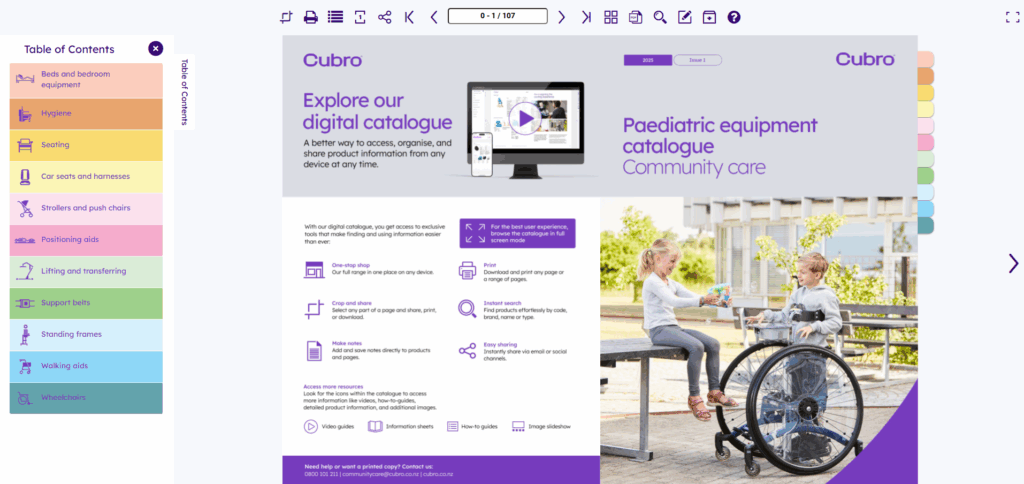
Cubro’s customers love using the digital catalog, especially with the added pop-up videos, product links, and navigational elements like the extended table of contents and Bookmark tabs.
Cubro, the leading provider of innovative healthcare equipment in New Zealand and Australia, created a digital catalog that automated the raw product data from their internal product data system. This intelligent catalog design outputs a visually polished, on-brand catalog that eliminates the need for manual layout updates and drastically reduces turnaround time.
Since implementation, Cubro discovered that the catalog is being used both internally by the sales team, and externally in the field, to great applause. They have been able to combine multiple product lines into one catalog effortlessly and streamline purchasing, through the catalog, driving engagement through call-to-action buttons and interactivity.
It’s a clear example of how ecommerce product catalog design isn’t just a sales tool – it’s an operational force. This is the next phase of ecommerce product catalog trends to watch: intelligent, automated catalog design that drives sales and increases customer connectivity.
Mobile-First Product Catalogs
Online, mobile-first product catalogs have become critical for eCommerce businesses. Shoppers are increasingly comfortable with shopping on devices – phones and tablets. It is important to design a catalog that is optimized for mobile and performs flawlessly on the small screen.
Key Features for Mobile Product Catalogs
- Responsive design that adapts layout, fonts, and images to different screen sizes
- Touch-friendly navigation with clear buttons, swipe gestures, and dropdowns
- Fast-loading pages optimized for slower mobile connections
- Mobile search and filters to help users quickly locate products
- Minimalist interfaces that highlight essential content and CTAs without clutter
A mobile-first approach ensures that product catalogs are not just viewable but fully functional across all devices.
Making the Most of Key Trends in 2025
The future of ecommerce is bright – dazzlingly so. In 2025, the key trends discussed here show you how businesses can prepare for these shifts and make the most of them. These advancements are shaping catalogs into intelligent tools that guide customers more efficiently from discovery to decision.
DCatalog helps you to make the most automation and real-time updates and design catalogs with mobile usability at the forefront. With our platform, you can incorporate stunning visual and interactive elements that help your ecommerce product catalog stand out.
See it in action – Reach out to one of our Publishing Executives today, or sign up for a free trial to experience our platform for yourself.